
The Sytewise Information Funnel
Sytewise is built around a hierarchy. Every piece of information in the system belongs somewhere. every work order, every checklist, every service record is in a structure that flows from the broadest context down to the most specific detail. Understanding that structure is the key to understanding why the system works the way it does, and how to get the most out of it.
The hierarchy has five levels, each one contained within the one above it.
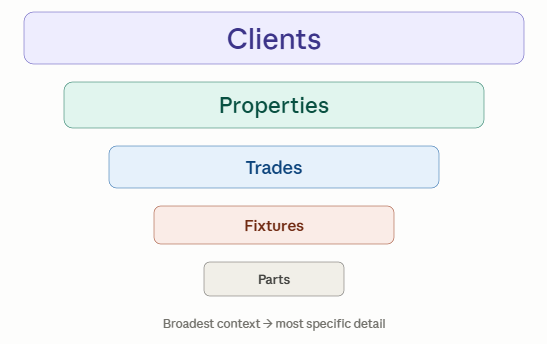
Clients sit at the top of the funnel. A client is the organization that owns or is responsible for the properties you manage. Everything below a client belongs to them.
Properties are the physical locations — buildings, sites, addresses — where work happens. Every property belongs to a client, and every trade, fixture, and work order ultimately traces back to a property.
Trades are the service categories within a property — HVAC, plumbing, electrical, AV systems, and so on. A trade is where you assign your preferred vendor, track your fixtures by type, and create work orders for a specific kind of work.
Fixtures are the individual assets and equipment tracked within a trade. Each fixture has its own record, its own service history, its own checklist archive, and its own parts list. The fixture is where the long-term value of the system accumulates — every job, every inspection, every replacement documented over time.
Parts are the component-level details inside a fixture — the serialized items, sub-assemblies, and consumables that make up the equipment itself. Parts are the most specific level of the funnel, and the most powerful for service documentation when populated accurately.
The funnel matters because it explains how Sytewise finds and organizes information. When you create a work order, you're working at the Trade level. When you attach fixtures to that work order, you're connecting it to the Fixture level. When a vendor documents parts replaced during the job, the record lands at the Parts level. Every piece of information knows exactly where it belongs — and that means you can always find it again.
The funnel also explains why setup order matters. Clients and properties need to exist before trades. Trades need to exist before fixtures. Fixtures need to exist before parts. Working top-down through the funnel when you set up a new location is the fastest path to a fully operational property record.
Hopefully you have as many clients as you want. Each of them can have several properties. Every property will employ vendors across several trades. Every trade will have several fixtures at each property. And every fixture is composed of its several parts.
At each level of the funnel, there are people who need information and people who can give you information about your assets.
Clients need information about their properties — how assets are performing, what work has been done, and what it cost.
Vendors need information about the property, the fixture, and the parts — enough context to arrive prepared, do the work right, and document what they found.
Tenants have helpful information about your property and need information about the work vendors are doing — closing the loop between the people who use the spaces and the people who maintain them.
Sytewise is the place to store everything — with an interface designed to support your daily tasks and surface the intelligence you need when you need it.