Descriptions Save You Time and Money
Searching for a specific type of fixture across your portfolio used to take a lot of time and guesswork. Sytewise can help you recall these fixtures in minutes without the guesswork, and fixture descriptions are the biggest part of what makes that possible.
The Detail Work
The more meaningful detail you put into a fixture description, the more visible that fixture becomes across your entire portfolio. Being able to pull up every fixture of a particular manufacturer, type, model, age, or location is not just a convenience -- it changes how you manage your properties. Subsets of fixtures that used to require a spreadsheet, several phone calls, and a fair amount of hoping someone remembered correctly can now be surfaced in a search that takes seconds. That visibility has direct operational value. You catch patterns earlier, plan maintenance more accurately, respond to service bulletins faster, and have honest conversations with clients and vendors based on what is actually installed rather than what you think is installed. Better data means better decisions, and better decisions mean better performing properties.
The Payoff
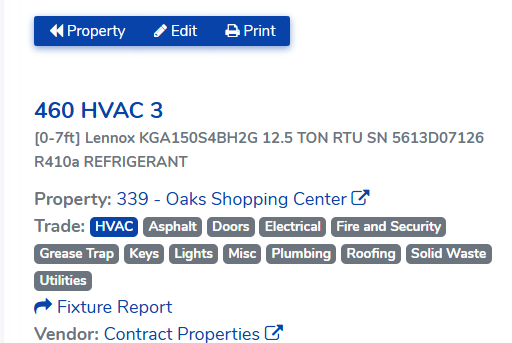
By giving an HVAC unit the description Lennox KGA150SVBH2G 12.5 TON RTU SN 5613D07126 R410a Refrigerant, you can now search your entire portfolio by manufacturer, model number, serial number, tonnage, rooftop versus ground mount, and refrigerant type. Search for Lennox and it appears. Search for 12.5 TON and it appears. Search for R410a and it appears alongside every other unit in your portfolio running that refrigerant. One well-written description makes a single fixture findable six different ways across every property in your account.
That matters when a refrigerant is being phased out and you need to know your full exposure. It matters when a manufacturer issues a service bulletin and you need to know which properties are affected. It matters when you are negotiating a service contract and need an accurate count of what is in scope. And it matters when you are planning capital replacements and want to know how many units of a particular age and type are still in service.
Different fixture types will call for different details. Make, model, and serial number are always a good starting point. Beyond that, think about what characteristics you are most likely to search for across your portfolio and include those. Tonnage and refrigerant type for HVAC. Screen size and resolution for displays. Lamp type and wattage for lighting. The test is simple -- if you might ever want to find every fixture like this one, put that detail in the description.